
Odom Release History Explained
Odom Correctional Institution was a North Carolina state prison in Jackson. NC DAC lists it among closed prisons, with closure in March 2022. The state had already announced a suspension of operations in 2019 and said incarcerated people would be relocated elsewhere in the prison system. A departure from Odom during that period is therefore most likely a placement change unless the statewide record also documents release from state prison custody.
That distinction prevents a common error. Facility departure says where a person stopped being housed. State release says when the prison custody episode ended. Release to post-release supervision means the person left prison but remained under NC DAC community supervision. An actual release date can also precede final sentence discharge. Read each label in the statewide record and do not collapse transfer, release, supervision, and discharge into one event.
Confirm an Odom State Release
The official route is NC DAC Offender Public Information. It contains current and historical information for people who served in state prison or participated in state community supervision. The state describes the history as extending back to 1972. It does not include ordinary county-jail-only records, so a Northampton County arrest without state prison or supervision may not appear.
- Search the offender number. Use the permanent state identifier when known because it reduces false matches.
- Search a careful name match. Compare age, demographic details, conviction county, and event history before selecting a record.
- Open the full record. Review status, incarceration events, sentence entries, admission dates, release dates, and supervision history.
- Locate the Odom placement. Treat the end of that placement as a transfer unless an actual state release event also appears.
- Request state records if needed. Ask NC DAC Combined Records for permissible basic information when public fields do not settle the history.
An inactive or released history can support the end of state custody, but it says nothing about a later arrest outside DAC. The Northampton County released-inmate lookup provides the wider route when the person's record crosses county jail, court, prison, federal, or immigration systems.
Why Odom Records Persist
Closure did not erase Odom's correctional history. NC DAC's offender database follows a person across facilities and community supervision, so the record can outlive both a transfer and a prison's operation. Search demand for an “Odom inmate release” may persist because family records, court papers, old audits, or web results still name the institution. The answer now comes from statewide history.
The official closed-prisons list is the clearest current status source. It places Odom's closure in March 2022. The older 2019 state announcement supplies the context that incarcerated people were to be relocated. Together, those sources establish why an old Odom entry should lead into NC DAC rather than to a purported live facility roster.
The NC DAC closed-prisons page documents the facility status shown below.
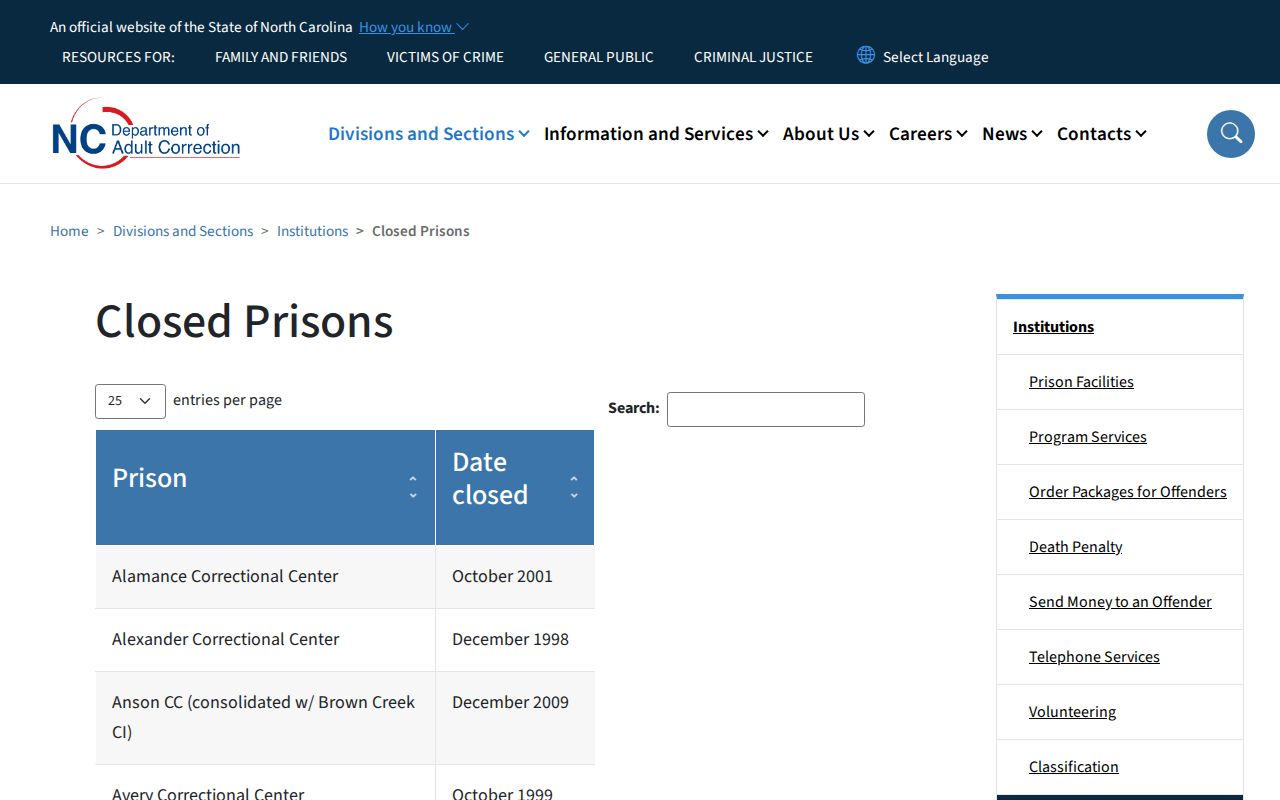
The source supports a closure finding, while the individual offender record remains necessary to prove a particular transfer or release.
Read Odom Release Records
A state offender record should be read as a sequence. The summary alone may omit the detail needed to tell a transfer from a release. Open the incarceration and supervision sections and preserve the exact labels. Do not substitute a next custody review date for a projected release date. A future projected date is an estimate, while an actual release date records an event that already occurred.
| State field | What it helps establish |
|---|---|
| Offender number | The durable identity used across NC DAC records |
| Incarceration status | Whether the person is active or historical in the state system |
| Admission and facility history | When the state custody episode began and where placement changed |
| Actual release date | The recorded end of that prison custody event |
| Projected release date | A future estimate that can change |
| Supervision status | Whether probation, parole, or post-release supervision continued |
Basic conviction, sentence length, time served, admission, and release data are generally public. Many other correctional or supervision records remain confidential. A request should seek specific existing fields and should not ask staff to create a new analysis.
The state record can also resolve a false match created by old Odom references. Compare the permanent offender number, conviction county, sentence entries, and sequence of incarceration events. An address or facility name from an old audit does not identify a person. When two people share a name, the record remains unresolved until stable identifiers and case facts point to the same individual.
Read projected and actual dates in their proper order. North Carolina does not apply a generic percentage rule to every sentence. Under structured sentencing, the imposed minimum controls, court-ordered jail credit counts toward that minimum, and earned time may affect the maximum within statutory limits. A projected date can move. An actual date establishes the state custody event that occurred, while a supervision field shows whether correctional control continued in the community.
Odom Records and Contact Route
No current Odom facility contact should be presented. An older official audit listed 485 Odom Prison Road in Jackson, but that is historical context, not a release counter. The correct records contact is NC DAC. Its public-records route explains how to seek records held by the state correctional agency and directs record-specific questions to the proper office.
NC DAC Public Records
Online guidance: NC DAC public records
Search gateway: Offender record gateway
Scope: State prison and state community-supervision records
Not covered: Ordinary city or county jail records
Ask for the offender's admission, movement, transfer, release, and supervision history if those fields are needed and lawfully available. Provide the offender number, full name, and enough detail to identify the record. If the state withholds or redacts a portion, request the statutory basis and the nonexempt remainder.
Recent Odom-Linked Releases
NC DAC also offers an Inmate Releases search for people released from state prison during the current calendar year and the two prior years. It can be searched by county, year, and month, or by all or part of a surname with a sounds-like option. Results can include offender number, name, release date, primary offense, and type of release. Open the linked offender record for context.
A Northampton “release county” value is a destination association. It does not mean the person left Northampton County jail, and it does not prove that Odom was the last prison placement. Use the individual record to connect the person to Odom and to establish the actual state release. For older events, use the broader Offender Public Information history rather than expecting the rolling release search to retain them.
After an Odom State Release
Structured-sentenced felons may leave prison for statutory post-release supervision. That status is outside prison custody but is not the same as final discharge. Eligible older cases and special statutory groups may involve parole. Probation can also appear in a state community-supervision history. The offender record can show “Probation/Parole/Post Release Status” and related sentence history.
If a public record shows active supervision, use NC DAC Community Supervision to locate the right office. Northampton is in Judicial District 6, whose published district contact is in Winton. Detailed supervision files are not generally public case files. Ask how to verify the publicly displayed status or reach the assigned office, not for confidential plans or case notes.
Odom and County Jail Records
Odom's state prison history and Northampton County Detention Center records belong to different custodians. NC DAC expressly says it does not hold ordinary county jail records. A person may have both histories, such as a county booking followed by state admission, but one database should not be used to fill gaps in the other.
Build a timeline from the county booking, court sentence, DAC admission, prison placements, actual state release, community supervision, and final discharge. Dates may differ because each measures a distinct event. The source agency at each point is the best place to resolve a true conflict. This method preserves the difference between leaving the closed Odom site and leaving state custody.
NC SAVAN can provide custody-change notice for a covered state event, but it is not the permanent Odom record. A SAVAN release alert identifies the reporting custodian and should be checked against the offender history when the exact event matters. Likewise, a Northampton court judgment can explain the sentence without proving which day the person moved out of Odom. State placement and release history remain with NC DAC.